
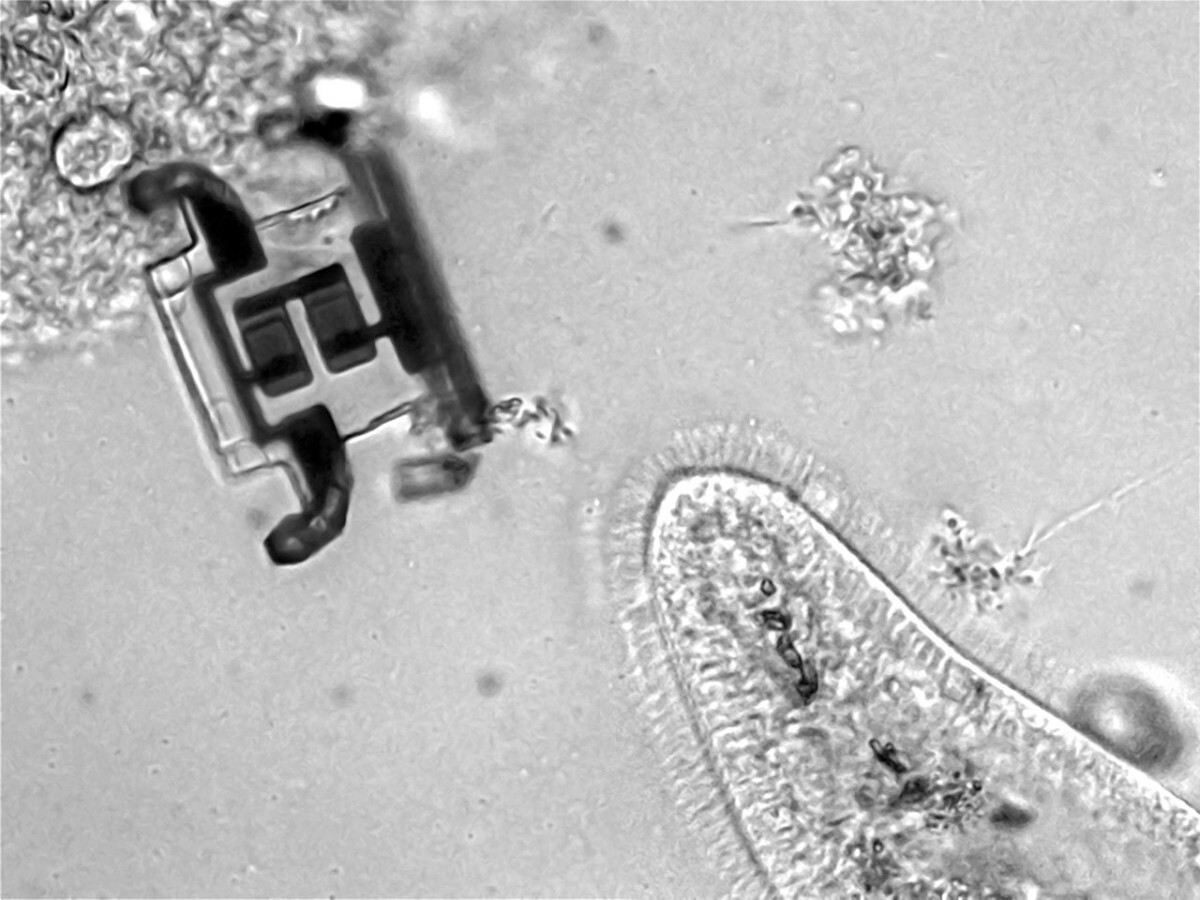
Electronically integrated, mass-manufactured, microscopic robots
#WakeUp
#ItsAllFake
#ThereIsNoVirus
😈💩👎
Article
Marc Z. Miskin,
Alejandro J. Cortese,
Kyle Dorsey,
Edward P. Esposito,
Michael F. Reynolds,
Qingkun Liu,
Michael Cao,
David A. Muller,
Paul L. McEuen &
Itai Cohen
Nature volume 584, pages557–561(2020)Cite this article
Abstract
Fifty years of Moore’s law scaling in microelectronics have brought remarkable opportunities for the rapidly evolving field of microscopic robotics1,2,3,4,5. Electronic, magnetic and optical systems now offer an unprecedented combination of complexity, small size and low cost6,7, and could be readily appropriated for robots that are smaller than the resolution limit of human vision (less than a hundred micrometres)8,9,10,11. However, a major roadblock exists: there is no micrometre-scale actuator system that seamlessly integrates with semiconductor processing and responds to standard electronic control signals. Here we overcome this barrier by developing a new class of voltage-controllable electrochemical actuators that operate at low voltages (200 microvolts), low power (10 nanowatts) and are completely compatible with silicon processing. To demonstrate their potential, we develop lithographic fabrication-and-release protocols to prototype sub-hundred-micrometre walking robots. Every step in this process is performed in parallel, allowing us to produce over one million robots per four-inch wafer. These results are an important advance towards mass-manufactured, silicon-based, functional robots that are too small to be resolved by the naked eye.
The authors declare that the data supporting the findings of this study are available within the paper and its supplementary information files. Source data are provided with this paper.
References
1.
Ceylan, H., Giltinan, J., Kozielski, K. & Sitti, M. Mobile microrobots for bioengineering applications. Lab Chip 17, 1705–1724 (2017).
2.
Li, J., de Ávila, B. E.-F., Gao, W., Zhang, L. & Wang, J. Micro/nanorobots for biomedicine: delivery, surgery, sensing, and detoxification. Sci. Robot. 2, eaam6431 (2017).
3.
Palagi, S. & Fischer, P. Bioinspired microrobots. Nat. Rev. Mater. 3, 113–124 (2018).
4.
Hu, C., Pané, S. & Nelson, B. J. Soft micro-and nanorobotics. Annu. Rev. Control Robot. Auton. Syst. 1, 53–75 (2018).
5.
Wang, W., Duan, W., Ahmed, S., Mallouk, T. E. & Sen, A. Small power: autonomous nano-and micromotors propelled by self-generated gradients. Nano Today 8, 531–554 (2013).
6.
Theis, T. N. & Wong, H.-S. P. The end of Moore’s law: a new beginning for information technology. Comput. Sci. Eng. 19, 41–50 (2017).
7.
Yeric, G. Moore’s law at 50: Are we planning for retirement? In 2015 IEEE Intl Electron Devices Meeting (IEDM) 1.1.1–1.1.8 (IEEE, 2015).
8.
Wu, X. et al. A 0.04 mm3 16 nW wireless and batteryless sensor system with integrated Cortex-M0+ processor and optical communication for cellular temperature measurement. In 2018 IEEE Symp. VLSI Circuits 191–192 (IEEE, 2018).
9.
Funke, D. A. et al. A 200 μm by 100 μm smart dust system with an average current consumption of 1.3 nA. In 2016 IEEE Intl Conf. Electronics, Circuits and Systems (ICECS) 512–515 (IEEE, 2016).
10.
Lee, S. et al. A 250 μm × 57 μm microscale opto-electronically transduced electrodes (MOTEs) for neural recording. IEEE Trans. Biomed. Circuits Syst. 12, 1256–1266 (2018).
11.
Seo, D., Carmena, J. M., Rabaey, J. M., Maharbiz, M. M. & Alon, E. Model validation of untethered, ultrasonic neural dust motes for cortical recording. J. Neurosci. Methods 244, 114–122 (2015).
12.
Viswanath, R. N., Kramer, D. & Weissmüller, J. Adsorbate effects on the surface stress–charge response of platinum electrodes. Electrochim. Acta 53, 2757–2767 (2008).
13.
Viswanath, R. N., Kramer, D. & Weissmüller, J. Variation of the surface stress–charge coefficient of platinum with electrolyte concentration. Langmuir 21, 4604–4609 (2005).
14.
Weissmüller, J. et al. Charge-induced reversible strain in a metal. Science 300, 312–315 (2003).
15.
Jin, H.-J. & Weissmüller, J. Bulk nanoporous metal for actuation. Adv. Eng. Mater. 12, 714–723 (2010).
16.
Sader, J. E. Surface stress induced deflections of cantilever plates with applications to the atomic force microscope: rectangular plates. J. Appl. Phys. 89, 2911–2921 (2001).
17.
Tamayo, J., Ruz, J. J., Pini, V., Kosaka, P. & Calleja, M. Quantification of the surface stress in microcantilever biosensors: revisiting Stoney’s equation. Nanotechnology 23, 475702 (2012).
18.
Conway, B. E., Birss, V. & Wojtowicz, J. The role and utilization of pseudocapacitance for energy storage by supercapacitors. J. Power Sources 66, 1–14 (1997).
19.
Wiggins, C. H. & Goldstein, R. E. Flexive and propulsive dynamics of elastica at low Reynolds number. Phys. Rev. Lett. 80, 3879–3882 (1998).
20.
Felgner, H., Frank, R. & Schliwa, M. Flexural rigidity of microtubules measured with the use of optical tweezers. J. Cell Sci. 109, 509–516 (1996).
21.
Ananthakrishnan, R. & Ehrlicher, A. The forces behind cell movement. Int. J. Biol. Sci. 3, 303–317 (2007).
22.
Piazza, G., Felmetsger, V., Muralt, P., Olsson, R. H. III & Ruby, R. Piezoelectric aluminum nitride thin films for microelectromechanical systems. MRS Bull. 37, 1051–1061 (2012).
23.
Sinha, N. et al. Piezoelectric aluminum nitride nanoelectromechanical actuators. Appl. Phys. Lett. 95, 053106 (2009).
24.
Zaghloul, U. & Piazza, G. 10–25 nm piezoelectric nano-actuators and NEMS switches for millivolt computational logic. In 2013 IEEE 26th Intl Conf. Micro Electro Mechanical Systems (MEMS) 233–236 (IEEE, 2013).
25.
Ebefors, T., Mattsson, J. U., Kälvesten, E. & Stemme, G. A walking silicon micro-robot. In Proc. 10th Intl Conf. Solid-State Sensors and Actuators (Transducers ’99) 1202–1205 (1999).
26.
Jager, E. W., Inganäs, O. & Lundström, I. Microrobots for micrometer-size objects in aqueous media: potential tools for single-cell manipulation. Science 288, 2335–2338 (2000).
27.
Jager, E. W., Smela, E. & Inganäs, O. Microfabricating conjugated polymer actuators. Science 290, 1540–1545 (2000).
28.
Smela, E. Microfabrication of PPy microactuators and other conjugated polymer devices. J. Micromech. Microeng. 9, 1–18 (1999).
29.
Palagi, S. et al. Structured light enables biomimetic swimming and versatile locomotion of photoresponsive soft microrobots. Nat. Mater. 15, 647–653 (2016).
30.
Dai, B. et al. Programmable artificial phototactic microswimmer. Nat. Nanotechnol. 11, 1087–1092 (2016).
31.
Ahmed, D. et al. Selectively manipulable acoustic-powered microswimmers. Sci. Rep. 5, 9744 (2015).
32.
Rao, K. J. et al. A force to be reckoned with: a review of synthetic microswimmers powered by ultrasound. Small 11, 2836–2846 (2015).
33.
Tottori, S. et al. Magnetic helical micromachines: fabrication, controlled swimming, and cargo transport. Adv. Mater. 24, 811–816 (2012).
34.
Leong, T. G. et al. Tetherless thermobiochemically actuated microgrippers. Proc. Natl Acad. Sci. USA 106, 703–708 (2009).
35.
Baraban, L. et al. Fuel-free locomotion of Janus motors: magnetically induced thermophoresis. ACS Nano 7, 1360–1367 (2013).
36.
Bassik, N. et al. Enzymatically triggered actuation of miniaturized tools. J. Am. Chem. Soc. 132, 16314–16317 (2010).
37.
Miskin, M. Z. et al. Graphene-based bimorphs for micron-sized, autonomous origami machines. Proc. Natl Acad. Sci. USA 115, 466–470 (2018).
38.
Solovev, A. A., Sanchez, S., Pumera, M., Mei, Y. F. & Schmidt, O. G. Magnetic control of tubular catalytic microbots for the transport, assembly, and delivery of micro-objects. Adv. Funct. Mater. 20, 2430–2435 (2010).
39.
Carlson, A., Bowen, A. M., Huang, Y., Nuzzo, R. G. & Rogers, J. A. Transfer printing techniques for materials assembly and micro/nanodevice fabrication. Adv. Mater. 24, 5284–5318 (2012).
40.
Wu, Z. et al. A swarm of slippery micropropellers penetrates the vitreous body of the eye. Sci. Adv. 4, eaat4388 (2018).
41.
Miskin, M. Z. et al. Fabrication of electronically integrated, mass-manufactured, microscopic robots. Protoc. Exch. https://doi.org/10.21203/rs.3.pex-1012/v1 (2020).
42.
Conway, B. E. Electrochemical oxide film formation at noble metals as a surface-chemical process. Prog. Surf. Sci. 49, 331–452 (1995).
43.
Climent, V., Gómez, R., Orts, J. M. & Feliu, J. M. Thermodynamic analysis of the temperature dependence of OH adsorption on Pt (111) and Pt (100) electrodes in acidic media in the absence of specific anion adsorption. J. Phys. Chem. B 110, 11344–11351 (2006).
44.
van der Niet, M. J., Garcia-Araez, N., Hernández, J., Feliu, J. M. & Koper, M. T. Water dissociation on well-defined platinum surfaces: the electrochemical perspective. Catal. Today 202, 105–113 (2013).
45.
Gisbert, R., García, G. & Koper, M. T. Adsorption of phosphate species on poly-oriented Pt and Pt (111) electrodes over a wide range of pH. Electrochim. Acta 55, 7961–7968 (2010).
46.
Lafouresse, M., Bertocci, U. & Stafford, G. Dynamic stress analysis applied to (111)-textured Pt in HClO4 electrolyte. J. Electrochem. Soc. 160, H636–H643 (2013).
47.
Raiteri, R. & Butt, H.-J. Measuring electrochemically induced surface stress with an atomic force microscope. J. Phys. Chem. 99, 15728–15732 (1995).
48.
Funke, D. A. et al. Ultra low-power, -area and -frequency CMOS thyristor based oscillator for autonomous microsystems. Analog Integr. Circuits Signal Process. 89, 347–356 (2016).
49.
Hwang, C., Bibyk, S., Ismail, M. & Lohiser, B. A very low frequency, micropower, low voltage CMOS oscillator for noncardiac pacemakers. IEEE Trans. Circ. Syst. I Fundam. Theory Appl. 42, 962–966 (1995).
50.
Galea, F., Casha, O., Grech, I., Gatt, E. & Micallef, J. Ultra low frequency low power CMOS oscillators for MPPT and switch mode power supplies. In 14th Conf. Ph.D. Research in Microelectronics and Electronics (PRIME) 121–124 (IEEE, 2018).
Acknowledgements
We acknowledge the CNF staff, in particular T. Pennell, J. Clark, V. Genova, C. Alpha and G. Bordonaro, for guidance and support with the fabrication process; S. Norris and B. Bircan for discussions; funding from the Army Research Office (ARO W911NF-18-1-0032), the Air Force Office of Scientific Research (AFSOR) MURI Grant FA2386-13-1-4118, the Cornell Center for Materials Research DMR-1719875, NSF Grant DMR-1435829 and the Kavli Institute at Cornell for Nanoscale Science. This work was performed at the Cornell NanoScale Facility, an NNCI member supported by NSF Grant NNCI-1542081.
Author information
Affiliations
Kavli Institute at Cornell for Nanoscale Science, Cornell University, Ithaca, NY, USA
Marc Z. Miskin, David A. Muller, Paul L. McEuen & Itai Cohen
Laboratory of Atomic and Solid-State Physics, Cornell University, Ithaca, NY, USA
Marc Z. Miskin, Alejandro J. Cortese, Edward P. Esposito, Michael F. Reynolds, Qingkun Liu, Paul L. McEuen & Itai Cohen
Department of Electrical and Systems Engineering, University of Pennsylvania, Philadelphia, PA, USA
Marc Z. Miskin
School of Applied and Engineering Physics, Cornell University, Ithaca, NY, USA
Kyle Dorsey, Michael Cao & David A. Muller
Contributions
M.Z.M., P.L.M. and I.C. conceived the experiments. M.Z.M. designed and fabricated the robots, carried out the experiments, and collected and analysed the data. M.Z.M. and A.J.C. developed the silicon fabrication procedure. M.Z.M and K.D. developed the platinum actuator fabrication procedure. M.Z.M, M.F.R. and Q.L. interpreted the platinum electrochemistry data. E.P.E., Q.L. and M.C. took TEM images characterizing the ALD platinum. M.Z.M., I.C. and P.L.M wrote the manuscript with all authors contributing.
Corresponding authors
Ethics declarations
Competing interests
The authors declare no competing interests.
Additional information
Publisher’s note Springer Nature remains neutral with regard to jurisdictional claims in published maps and institutional affiliations.
Extended data figures and tables
a, X-ray reflectometry thickness measurements as a function of the number of growth cycles of ALD. The first 30 cycles are a nucleation phase where the film grows rapidly in thickness. Once the surface is covered in platinum, a bulk growth phase begins at a slower rate. b, Resistivity measurements (via four-point probe) as a function of ALD cycle number. We interpret the dramatic drop in resistivity after about 30 cycles as clear evidence that a continuous electrical film has formed. Source data
a, Cross-sectional TEM image of a titanium–platinum SEA structure, with colours coded by electron energy loss spectroscopy. Silicon is shown in red, titanium in green, oxygen in blue and platinum in white. b, In-plane TEM image of an ALD platinum film showing crystal grain sizes of approximately 10 nm. Scale bars, 10 nm.
The curvature in a SEA is set by both adsorption of ions and pre-stresses built up during fabrication. Here we plot the curvature of a titanium–platinum SEA in the absence of any applied bias as a function of the titanium layer thickness. The curvature varies continuously from positive to negative as the titanium layer is increased. As the voltage is fixed to the open circuit potential, this effect is purely due to pre-stress. The sign of the curvature inverts at a titanium thickness of around 4 nm. Overall, the pre-stress provides an added level of control over the three-dimensional structure formed using SEAs and rigid panels. Source data
a, Top: cyclic voltammogram of a titanium–platinum SEA over a large voltage range versus Ag/AgCl, swept at 1 V s−1. Standard features of platinum electrochemistry are observed: hydrogen adsorption and desorption peaks from about −0.5 V to −0.9 V and a broad peak at positive voltages that includes both oxygen-species adsorption and later oxidation of the platinum. When the sweep returns from the oxidation regime, there is an oxide reduction peak at about −0.3 V. Bottom: the curvature of a SEA over the same range, showing strong hysteresis in the platinum oxidation regime. b, Top: cyclic voltammogram for a titanium–platinum SEA, sweep rate 400 mV s−1, over a narrower sweep range, avoiding oxidation of the platinum. We find that the cyclic voltammogram is relatively reversible in both the hydrogen and oxygen adsorption/desorption regimes. Bottom: the curvature of a SEA over the same quasi-reversible range of voltages. We observe two branches of actuation, the hydrogen and oxygen-species adsorption regimes, each with a small amount of hysteresis. All measurements were performed in phosphate-buffered saline solution. Source data
a, Cyclic voltammogram for a graphene–platinum SEA that is 70 μm long and 13 μm wide over the voltage range used here to actuate the robots: the oxygen-species adsorption/desorption regime. b, The SEA curvature (red dots) and the capacitive portion of the response (blue crosses). The latter is obtained by removing current that does not depend on the voltage sweep direction (Methods). A peak in charge transfer occurs in the same region where bending takes place. The integrated magnitude of charge transferred gives a surface charge density of 130 μC cm−2, consistent with typical values for oxygen-species adsorption43,44,45 The data are well represented by a standard charge transfer model with nearly ideal adsorption (dashed lines) (Methods). Source data
a, A labelled scanning electron microscopy image of a silicon photovoltaic, 10 μm by 20 μm in size. b, A schematic cross-section of one of our photovoltaics. c, A current–voltage curve for a photovoltaic with (red curve) and without (blue curve) illumination. The devices were illuminated by a 785-nm wavelength laser with an intensity of 100 nW μm−2. The illuminated current–voltage curve shows an open circuit voltage (Voc) of approximately 700 mV. Source data
a, Schematics of the three surfaces robots walked on: hexagonal arrays of knobs spaced 5 μm apart and 10 μm apart, and random arrays of knobs. b, We measure the maximum lateral velocity a robot takes at each step, then aggregate the results into a distribution of peak speeds for each robot body type and frictional surface type (robot types are depicted in the inset images). The upper and lower error bars represent the upper and lower quartiles. Substantial variability is expected for walking on rough surfaces: each step can provide a different contact geometry and force. The order of magnitude is constrained by an interplay between friction and drag: the robot speed is bounded by the maximum frictional force the feet can generate. The maximum frictional force is found to be 0.1–0.3 of the robot’s weight, consistent with friction. (See Methods for a detailed discussion). Source data
Supplementary information
Changing the voltage on a SEA relative to the surrounding electrolyte. Surface adsorption causes the actuator to curl to micron scale radii of curvature over small changes in voltage. (This video is in real time).
An array of electrically actuated SEAs. Actuators curl and uncurl together in response to the voltage signal on a common electrode. (This video is in real time).
Real-time video of the release of thousands of robots into solution. The robots self-fold upon release.
A four-photovoltaic robot walking across a microscope slide. A focused laser beam is directed to specific photovoltaics on the robot body, powering a corresponding set of actuators, and causing the robot to walk across a surface. (The video has been sped up by 8×).
A two-photovoltaic robot walking across a microscope slide. A focused laser beam is directed to specific photovoltaics on the robot body, powering a corresponding set of actuators, and causing the robot to walk across a surface. (The video has been sped up by 8×).
A microscopic robot walking in a circle. By changing the pattern of the rigid panels, we can change the robot’s locomotion. Here the back legs are rotated slightly relative to the robot body during fabrication. As a result, the robot walks in a circle. (This video has been sped up by 8×).
Microscopic robots drawn into a syringe. Due to their small size, microrobots are robust to handling, even when using macroscopic tools like syringes. (This video is in real time).
A robot actuating following injection through a pipette. In this video, a robot has been injected into an amoeba culture, demonstrating the robots are robust to handling. (This video is in real time).
Source data

